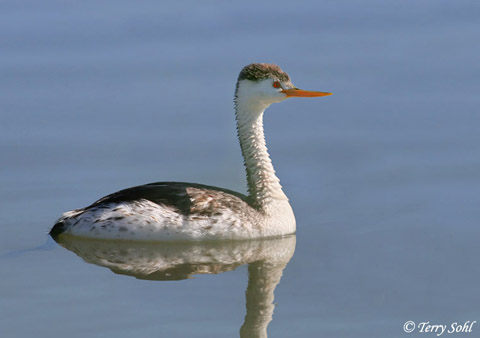
The Clark's Grebe is identical in size and shape to the Western Grebe, and was once considered to be a lighter morph of that species. It breeds on large lakes, reservoirs, and marshes with extensive emergent vegetation, where floating nests are anchored among reeds and cattails. Clark's Grebes feed primarily on fish, which they capture by diving underwater and pursuing prey with their feet. During migration and winter, they use large inland lakes and coastal marine waters. Like the Western Grebe, the species is famous for its synchronized display, in which pairs run side-by-side across the water's surface.
Habitat
The Clark's Grebe inhabits large freshwater lakes, reservoirs, marshes, and wetlands with extensive open water and emergent vegetation for nesting. During migration and winter it also occurs on large inland lakes, estuaries, bays, and protected coastal marine waters where fish are abundant.
Diet
The Clark's Grebe feeds primarily on fish captured during underwater dives in open water. It also eats aquatic insects, crustaceans, and other small aquatic animals, especially during the breeding season.
Behavior
The Clark's Grebe spends most of its time swimming and diving on open water, where it pursues fish beneath the surface. It is highly social during the breeding season and is famous for elaborate courtship displays, including synchronized head-shaking and dramatic behavior in which pairs run side-by-side across the water.
Nesting
June and July. The Clark's Grebe nests in colonies on large lakes and marshes, usually among cattails, bulrushes, or other emergent vegetation. The pair builds a floating platform of aquatic plants anchored to surrounding vegetation and lays 2–5 eggs. After hatching, young chicks often ride on the backs of their parents while being cared for and protected.
Song
The Clark's Grebe gives loud, sharp, and sometimes harsh kre-eeeed and kek-kek-kek calls that carry well across open water. Pairs frequently exchange vocalizations during courtship displays, and colonies can be quite noisy during the breeding season.
Migration
The Clark's Grebe breeds primarily on large lakes, reservoirs, and marshes of the western United States, southern Canada, and parts of northern Mexico. After breeding, many birds migrate to winter along the Pacific Coast from British Columbia south through California and into Mexico, while others remain year-round where open water persists. During migration, they may occur on large inland lakes and reservoirs throughout the western interior of North America.
Similar Species
Western Grebe. See ID Key's for Clark's vs. Western Grebe .
Status
The Clark's Grebe is generally considered a species of low conservation concern, although local populations can be affected by wetland loss, shoreline development, water-level fluctuations, and disturbance at nesting colonies. Oil spills, entanglement in fishing gear, and degradation of large lake and coastal habitats also pose threats in some parts of its range. The species may be expanding its range to the east in recent decades. The IUCN considers Clark's Grebe to be a species of "least concern".
Photo Information
June 19th, 2008 - Klamath National Wildlife Refuge, California - Terry Sohl
Interactive eBird Map
Click to access the interactive eBird species sightings page for Clark's Grebe
